
News
Oil and gas drilling platform crisis exercise
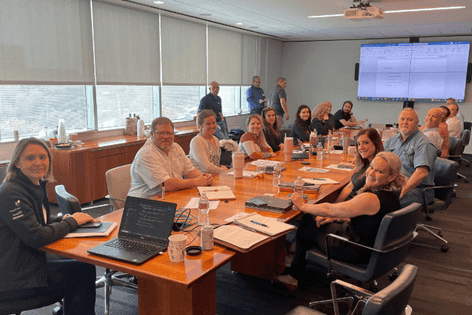
Kenyon ran a simulation exercise with Seadrill at its Emergency Response Center in Houston to test the company's Emergency Response Plan. Over 20 Seadrill staff took Incident Management Team roles for a fatality scenario on a Gulf of Mexico drilling platform lasting nearly five and a half hours, with Kenyon simulating a Family Assistance Centre, mental health support and live call centre activity. Kenyon offers table-top, simulation and full-scale exercises.
We offer a range of exercises and simulations that allow you to test your Emergency Response Plan (ERP) and response team to understand what works and what doesn’t, as well as giving staff an opportunity to practice. This ensures that when faced with a real emergency, your response is smoother and effective.
Testing Seadrill's Emergency Response Plan in Houston
We recently had the pleasure of running a simulation exercise with Seadrill to test their Emergency Response Plan (ERP).
Jonathan Huth, Operations Manager, US, and Janie Moreno, Director, Call Centre Services, US, joined over 20 Seadrill staff at the Seadrill Emergency Response Center (ERC) in Houston, Texas, US. The Seadrill participants took on key positions of responsibility within the Incident Management Team (IMT) for a fatality exercise on board an oil and gas drilling platform in the Gulf of Mexico.
What the five-hour fatality exercise involved
The exercise started at 08.00 CST and ran for nearly 5 and a half hours. A key part of the exercise was Kenyon simulating an activation of services for Seadrill. This included:
- assisting over 55 employees affected by providing a Family Assistance Centre (FAC), mental health support and investigation support for the incident.
- utilising the Kenyon call centre enabled Seadrill role players to make calls to the call centre team to experience and get a real feeling of the inbound notifications available to our clients who have retained the service in a real crisis.
The exercise concluded with feedback provided to all participants and we’ll continue to work with Seadrill, assisting them to continue enhancing their ERP and crisis procedures.
Which crisis exercises does Kenyon offer?
This is an example of the crisis exercises we offer, that can be fully customised and are created by utilising our 115+ years of experience, responding to over 400 fatal and non-fatal incidents, ensuring scenarios that are close as possible to an actual crisis and delivering critical improvements to your ERP.
These exercises and simulations include:
- Table-top - Familiarise designated staff with the contents of the ERP
- Simulation - Test your response to a specific scenario, setting the stress level and intensity as needed
- Full-scale - Closest you’ll get to testing your crisis management system outside of responding to an actual crisis.
If you’d like to find out more about how we can assist in creating and testing your organisations ERP, speak to our crisis management experts at kenyon@kenyoninternational.com.